Chinese dragon back in California parade for first time since 1908
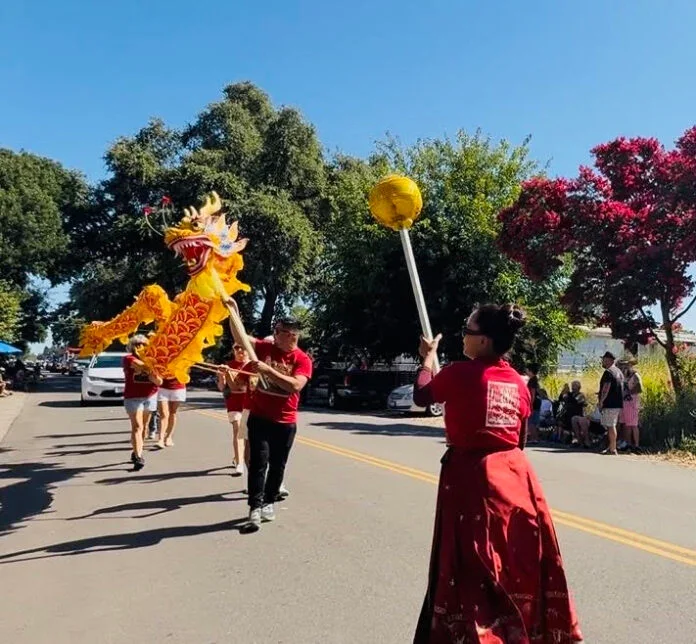
Chinese dragon returns to 4th of July parade in Red Bluff, CA. From Helen & Joe Chew Foundation
By Randall
July 6, 2026
(Editor’s Note: The Helen & Joe Chew Foundation submitted this story to AsAmNews)
Some moments remind us that history is never truly gone. It simply waits for someone to carry it forward.
On Independence Day, the descendants of Red Bluff’s Historic Chinatown did just that.
For the first time in 118 years, a Chinese dragon once again wound its way through a Tehama County Fourth of July parade, recreating a tradition first documented in 1908 when members of Red Bluff’s Chinese community proudly participated, after being invited in the town’s Independence Day celebration with the legendary Moo Lung Dragon from Marysville.
As the dragon traveled down Historic Route 99 during the Los Molinos Independence Day Parade, it represented far more than a cultural performance. It became a living reminder of the generations of Chinese families who helped shape Tehama County those who built businesses, practiced traditional medicine, working in agriculture and general commerce, raising families, and celebrating alongside their neighbors.
The reenactment was inspired by years of historical and genealogical research conducted by the Helen & Joe Chew Foundation while preparing Images of America: Chinese in Tehama County. Newspaper accounts documenting the 1908 parade revealed a remarkable chapter of local history that had largely faded from public memory over the course of 118 years.
This year’s participation was part of a nationwide America250 celebration coordinated through the Chinese Historical Society of America, bringing together more than 30 Chinese lion and dragon dance teams participating in Independence Day parades across the United States. Red Bluff’s Historic Chinatown proudly represented Tehama County by reviving its own local tradition and sharing it with a new generation while parading.
For the descendants carrying the dragon, had a profound personal meaning.
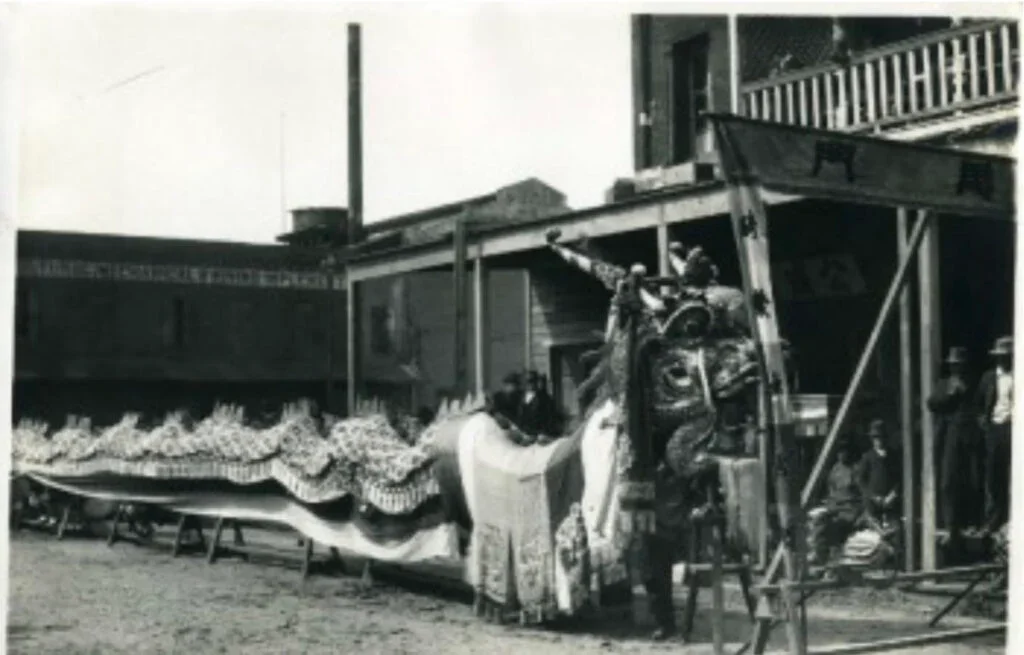
Moo Lung Dragon in Marysville circa 1900’s courtesy of the Chinese American Museum of Northern California.
They were not simply honoring the past but they were retracing the footsteps of their own ancestors, whose lives became part of the story of Tehama County more than a century ago. Their participation reflected both pride in being Americans and deep gratitude for the community where their family’s roots took hold because it was one of the few towns that welcomed chinese immigrants labor.
Once again, the Tehama community’s response was overwhelming. Spectators lined the parade route, waving flags, applauding the dragon, and embracing a story that had been absent from public memory for more than a century. Before the parade even began, the story had already been featured in four publications, reflecting growing interest in preserving Tehama County’s diverse history. By the end of the celebration, Red Bluff’s Historic Chinatown was awarded First Place in the Novelty Division, recognizing both the sensation and historical significance of their presence.
The Helen & Joe Chew Foundation expressed heartfelt gratitude to the Chinese Historical Society of America, David Lei, Jeannie May Lim, the Redding School District, Redding School of the Arts, the Los Molinos Chamber of Commerce, volunteers, and everyone who helped bring the event to life.
Most importantly, the foundation thanked the people of Tehama County.
“Every wave, every smile, and every cheer reminded us that this history belongs to all of us,” said Foundation President Jessica Chew. “We hope our ancestors would be proud to see that, 118 years later, their story is still being told.”
As America approaches its 250th anniversary, the return of the dragon served as more than a celebration of the nation’s birthday. It became a reminder that the American story is built from countless local stories—stories of families who found opportunity, built communities, and contributed to the places they called home.
On this Fourth of July, one of those stories came home.
One hundred eighteen years later, the dragon returned—not simply to honor the past, but to remind us that history lives on whenever a community chooses to remember it.